Worried your products might be blocked from key global markets over compliance issues? A simple certification mistake can deny access to millions of consumers and hurt your brand's reputation.
To ensure global market access, your capsules need more than a certificate. True compliance requires an integrated system managing every production step, from sourcing to maintenance, ensuring your product completely respects cultural and religious standards.

I've seen many companies focus only on that final piece of paper. They often miss the critical details that can make or break their entry into new markets. It's a common mistake, but one that can be very costly. Let's look at what really goes into making a capsule that is truly compliant, not just certified. It’s a story about process, not just a stamp of approval.
You think your raw materials are certified, so you're safe, right? But hidden contaminants like industrial lubricants or cleaning agents can invalidate your product's religious status1, causing expensive recalls.
Avoiding cross-contamination means purifying the entire production line. This includes using certified lubricants and cleaning agents, implementing strict staff protocols, and ensuring every single element touching the capsule meets stringent Halal and Kosher standards2.

In my years in this industry, I've learned that the most dangerous risks are the ones you can't see. We call this the "invisible red line" of cross-contamination. True religious compliance is not just about using Halal or Kosher gelatin. It's about everything that comes into contact with the product, no matter how brief. Think about the lubricants used in the machinery or the release agents on the molds. If these aren't certified, the entire batch is compromised. We had to completely overhaul our maintenance procedures to ensure every substance used was compliant. This includes sanitization processes and even protocols for our employees, like dedicated changing rooms and specific hand-washing procedures3, to eliminate any chance of contamination. This level of detail shows a deep respect for our clients' beliefs, which builds far more trust than a certificate alone.
| Practice Area | Standard Approach | Religiously Compliant Approach |
|---|---|---|
| Machine Lubricants | Industrial-grade, petroleum-based | Food-grade, certified Halal/Kosher lubricants |
| Mold Cleaning | Standard chemical solvents | Certified cleaning agents, validated procedures |
| Staff Protocols | Basic hygiene standards | Segregated facilities, dedicated uniforms, audited protocols |
| Air Filtration | Standard dust control | Advanced filtration to prevent airborne particle contamination |
Are all Halal and Kosher certifications created equal for global markets?
You have a Halal certificate, but your shipment is stuck at customs in a key market. Why? Not all certifications are recognized everywhere, putting your entire distribution plan at risk.
Global certifications are not uniform.4 The authority of the certifying body (CB) is crucial.5 For example, MUI Halal is vital for Indonesia6, while specific Kosher agencies are preferred in North America7. Choosing the right CB determines your product's access to high-value retail channels.

I learned this lesson the hard way early in my career. A client was trying to enter the Indonesian market, one of the largest for Halal products. They had a Halal certificate, but it wasn't from a body recognized by MUI, the Indonesian Ulama Council. Their entire shipment was held up. This experience taught me that the certification world has a clear "layered logic." It’s not about having a certificate; it’s about having the right one for your target market. The same is true for Kosher. Some agencies are universally respected, while others are only accepted by certain communities. Furthermore, there are special requirements like "Kosher for Passover," which prohibits contact with grains and requires a complete production line shutdown and deep cleaning8. Understanding these nuances is what separates a simple supplier from a strategic partner. We help our clients navigate this complex landscape so they don't face costly delays.
| Region/Market | Key Certification Body | Strategic Importance |
|---|---|---|
| Indonesia, Malaysia | MUI, JAKIM | Essential for market entry; highest authority |
| Middle East (GCC) | ESMA (UAE), SFDA (Saudi) | Required for access to major Gulf markets |
| North America (Kosher) | OU, Star-K, cRc | Widely recognized by major retailers and consumers |
| Global (General) | IFANCA, HMC | Broad acceptance in many Western and Asian markets |
How does chemical purity connect with religious compliance in modern capsules?
Your product is Halal-certified, but today's consumers demand "clean label" products. Are you prepared for this new intersection of chemical purity and religious standards that is reshaping our industry?
Top-tier capsules today must be both religiously "clean" and chemically "pure." This means going beyond certification to offer options like titanium dioxide-free (TiO2-free) and SLS-free capsules, ensuring the product meets the highest standards of both faith and health-conscious consumers.
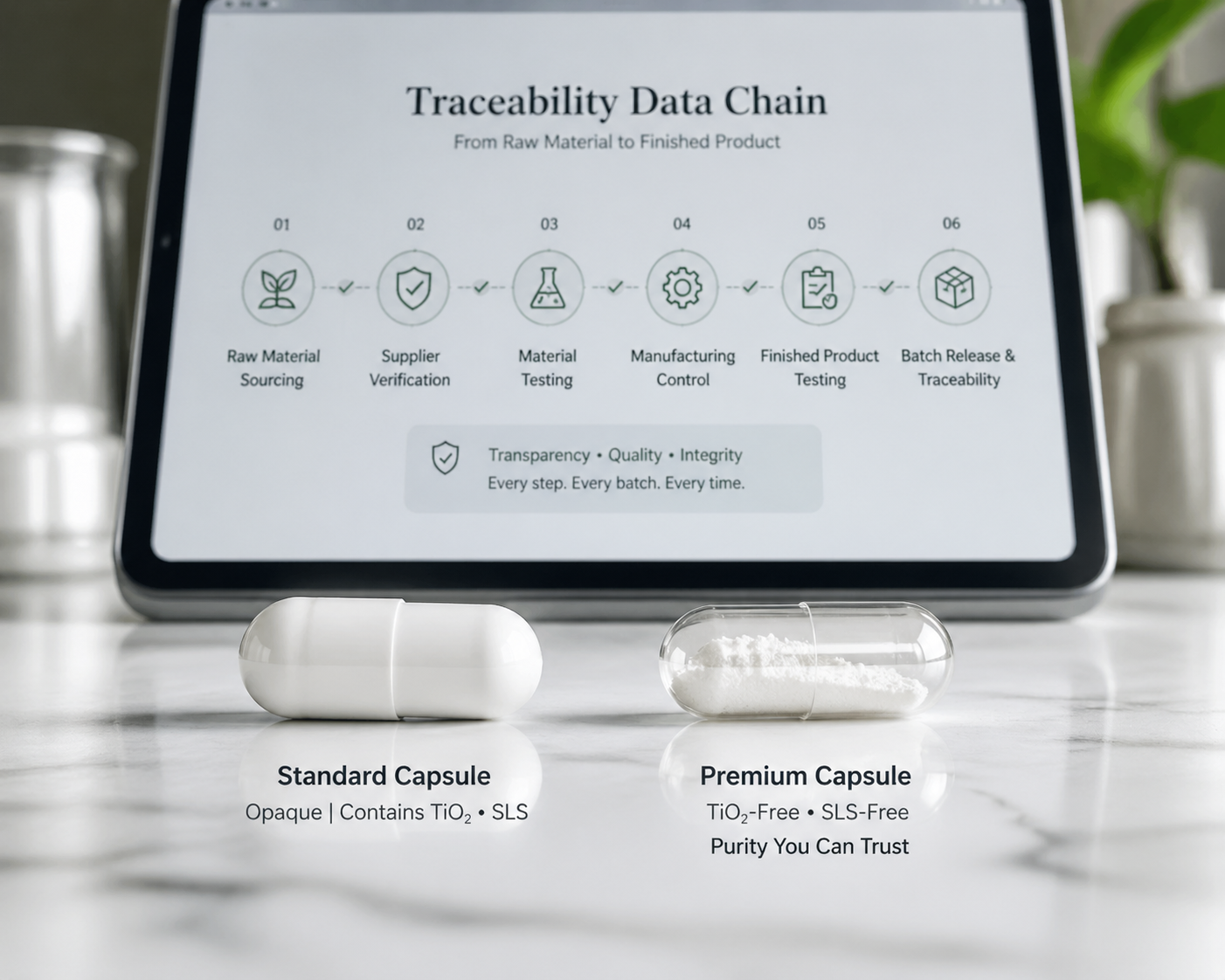
The conversation is changing. For years, the focus was solely on religious rules. Now, a new standard is emerging where religious "cleanliness" must align with chemical "purity." A product can be perfectly Halal but still contain additives like titanium dioxide (TiO2), which many consumers now want to avoid9. This is where we decided to innovate. We are building our reputation on providing capsules that meet both requirements. Trust is everything for our clients, especially large pharmaceutical companies that are terrified of "source risk." To address this, we implemented a complete traceability system10. We can track the gelatin from the specific slaughterhouse—ensuring it meets Halal or Kosher standards—all the way to the finished capsule. This complete data chain proves that our products are not only religiously compliant but also free from unwanted chemical additives. It’s the future of capsule manufacturing.
Key Traceability Checkpoints
- Raw Material Source: Verification of Halal/Kosher slaughtering practices and animal source.
- Processing: Dedicated production lines to prevent any cross-contamination with non-compliant materials.
- Additives: Full documentation and certification for all colorants and processing aids, confirming they are TiO2-free and SLS-free.
- Final Product: Batch-level testing and final certification to provide a complete data chain for our clients.
Conclusion
Religious certification isn't just a market entry pass; it's insurance for your brand's reputation. We deliver an audited supply chain standard that guarantees compliance, quality, and peace of mind.
"Halal Certification for Cleaning Chemicals", https://halalfoundation.org/halal-certification-for-cleaning-chemicals/. Halal and kosher production standards commonly treat processing aids, cleaning agents, and incidental-contact materials as relevant to product status, supporting the claim that noncompliant auxiliary substances can affect certification. Evidence role: mechanism; source type: institution. Supports: Noncompliant lubricants or cleaning agents may compromise halal or kosher status through production contact.. Scope note: Specific invalidation depends on the certifying authority, product category, and exposure level. ↩
"[PDF] Halal certification for an industrial machine intended to come in ...", https://digitalcommons.njit.edu/cgi/viewcontent.cgi?article=2568&context=theses. Certification guidance for halal and kosher manufacturing emphasizes that ingredients, equipment, processing aids, and production contact surfaces can be material to compliance, supporting the need to evaluate contact points across production. Evidence role: expert_consensus; source type: institution. Supports: Materials and equipment that contact capsules should be assessed for halal and kosher compliance.. Scope note: The exact scope of required review varies by certifier and by whether contact is direct, indirect, or incidental. ↩
"addendum 2: current good manufacturing practices (cgmp)", https://www.fda.gov/media/149982/download. Food-safety and GMP guidance identifies personnel hygiene controls, including handwashing and controlled changing practices, as measures that reduce contamination risks in manufacturing environments. Evidence role: mechanism; source type: government. Supports: Personnel hygiene and changing protocols help reduce contamination risk in production.. Scope note: Food-safety guidance supports contamination control generally; it does not by itself establish a religious requirement unless incorporated by a certifier. ↩
"[PDF] Updated List of Foreign Halal Certification Bodies for 2025 ...", https://apps.fas.usda.gov/newgainapi/api/Report/DownloadReportByFileName?fileName=Updated%20List%20of%20Foreign%20Halal%20Certification%20Bodies%20for%202025-2028_Bangkok_Thailand_TH2025-0039.pdf. International halal and kosher certification systems are administered by multiple authorities and accreditation bodies with differing recognition arrangements, supporting the claim that certification acceptance is not globally uniform. Evidence role: general_support; source type: institution. Supports: Halal and kosher certification recognition varies across jurisdictions and certifying bodies.. Scope note: The statement is broad; evidence should describe variability rather than imply that all certificates are incompatible across borders. ↩
"[PDF] Updated List of Foreign Halal Certification Bodies for 2025 ...", https://apps.fas.usda.gov/newgainapi/api/Report/DownloadReportByFileName?fileName=Updated%20List%20of%20Foreign%20Halal%20Certification%20Bodies%20for%202025-2028_Bangkok_Thailand_TH2025-0039.pdf. Accreditation and import-control frameworks show that authorities often require certification from approved or recognized bodies, supporting the importance of the certifying body's recognized status. Evidence role: general_support; source type: government. Supports: The recognized authority of the certifying body can determine whether a certificate is accepted.. Scope note: The degree of importance depends on the destination market and product category. ↩
"[PDF] Report Name:Indonesia's Expanding Halal Standards with Trade ...", https://apps.fas.usda.gov/newgainapi/api/Report/DownloadReportByFileName?fileName=Indonesia%27s%20Expanding%20Halal%20Standards%20with%20Trade%20Impacts%20on%20the%20Horizon_Jakarta_Indonesia_ID2025-0035. Indonesian halal law and official halal-assurance materials identify Indonesia's formal halal-certification system and the role of recognized halal authorities, supporting the claim that Indonesia requires market-specific halal compliance. Evidence role: historical_context; source type: government. Supports: Market entry into Indonesia requires attention to Indonesia-specific halal certification recognition.. Scope note: Since Indonesia's halal system has evolved from MUI-centered certification toward BPJPH administration with MUI involvement, the citation should clarify the current institutional arrangement. ↩
"Acceptable Kashrus Agencies - cRc Consumer Kosher", https://consumer.crckosher.org/acceptable-kashrus-agencies/. Kosher certification literature and institutional directories identify multiple North American kosher agencies and indicate that consumer and retailer acceptance often depends on agency recognition, supporting the claim that agency identity matters. Evidence role: expert_consensus; source type: institution. Supports: Recognition of kosher agencies varies, and some agencies have broader acceptance in North American markets.. Scope note: Preference varies by retailer, community, and product category; no single source is likely to prove universal North American preference. ↩
"[PDF] Cleaning & Kashering for Pesach Chart | STAR-K", https://www.star-k.org/articles/wp-content/uploads/cleaning-kashering-chart.pdf. Passover kosher guidance explains the prohibition on chametz and the need to kasher or specially prepare equipment used for Passover production, supporting the claim that Passover status can require strict avoidance and intensive line preparation. Evidence role: definition; source type: institution. Supports: Kosher for Passover production requires avoidance of chametz and special equipment preparation or cleaning.. Scope note: The exact requirements for shutdown duration and cleaning validation depend on the certifying agency and the prior use of the equipment. ↩
"[PDF] Report Name:Titanium Dioxide Banned as a Food Additive in the EU", https://apps.fas.usda.gov/newgainapi/api/Report/DownloadReportByFileName?fileName=Titanium%20Dioxide%20Banned%20as%20a%20Food%20Additive%20in%20the%20EU_Brussels%20USEU_European%20Union_E42022-0011.pdf. Food-safety assessments and regulatory actions, including the European Food Safety Authority's conclusion that titanium dioxide could no longer be considered safe as a food additive, provide context for why TiO2-free formulations have become relevant to clean-label discussions. Evidence role: historical_context; source type: government. Supports: Titanium dioxide has become an additive of concern, contributing to demand for TiO2-free products.. Scope note: Regulatory concern does not directly measure consumer preference and may not apply identically to pharmaceutical capsule uses in all jurisdictions. ↩
"FSMA Final Rule on Requirements for Additional Traceability Records", https://www.fda.gov/food/food-safety-modernization-act-fsma/fsma-final-rule-requirements-additional-traceability-records-certain-foods. Traceability standards in food and pharmaceutical supply chains define systems for following materials through sourcing, processing, and distribution, supporting the claim that end-to-end records can document origin and production history. Evidence role: definition; source type: institution. Supports: A complete traceability system can track raw materials through manufacturing to the finished capsule batch.. Scope note: Traceability documents movement and identity; it does not by itself prove religious compliance unless linked to audited halal or kosher controls. ↩